This easy-to-use guide includes information, tips and videos showing:
- how to use our products
- how to choose the best product for your application and laser source
What are the differences between our products?
Temporal characterization
All our temporal characterization products are based on the dispersion scan technique. Each product measures the SHG spectrum of your laser as a function of dispersion and retrieves the spectral phase and intensity of the laser pulse. The full temporal characteristics are then obtained via Fourier Transform.
The main differences between products are the type of measurement (scanning or single-shot), the shortest/longest pulse that can be measured, and if the instrument can also simultaneously compress the pulse. The table below summarizes the main differences between our temporal characterization product families. See the product pages for more detailed information.
TL = Transform Limit, the same as FTL = Fourier Transform Limit. The TL pulse duration is the shortest and highest peak power pulse with a given spectral intensity, and has a flat spectral phase. Our products measure much longer durations of chirped pulses (the longest chirped pulse duration depends on the model).
| measures | measures and compresses | single shot | TL: 2.5fs | 4 fs | 6 fs | … | 60 fs | 400 fs | |
| d-scan | X | X | |||||||
| d-max | X | ||||||||
| b-shot | X | X |
Spatio-temporal measurements
The ICE product performs spatio-temporal characterization of femtosecond laser pulses with duration of 3 fs to 30 fs (in the Fourier transform limit), and a useable beam input aperture of up to 12 mm . The software GUI application allows post-processing of the acquired data to extract useable information such as Zernike polynomials, spatial chirp along X and Y as a function of wavelength, and more. The wave-propagation simulation tool allows you to simulate the waveform under forward or backward propagation, and the use of focusing optics.
CEP-Tag measurements
The CEP-tag product provides measurement of the Carrier Envelope Phase (CEP) offset of amplified laser pulses at single-shot. It is based upon traditional f-2f interferometry, where the second harmonic of the red edge of an octave-spanning spectrum is spectrally interfered with the blue edge. Detection is based on a photodiode array and the use of Field-Programmable Gate Array (FPGA) electronics enables us to determine the CEP of every pulse at a rate of 170 kHz, and of individual pulses at up to 600 kHz. See the product page for higher pulse rates and more information.
VIS-SWIR (500-1700 nm) Spectral measurements
The d-vision is a VIS-SWIR spectrometer with a single-sensor capable of covering the 500-1700 nm spectral band, without the hassle of stitching spectra. Several wavelength ranges are available, with resolutions from 0.7 nm to 3 nm depending on your grating selection. See the product page for more information.
d-scan
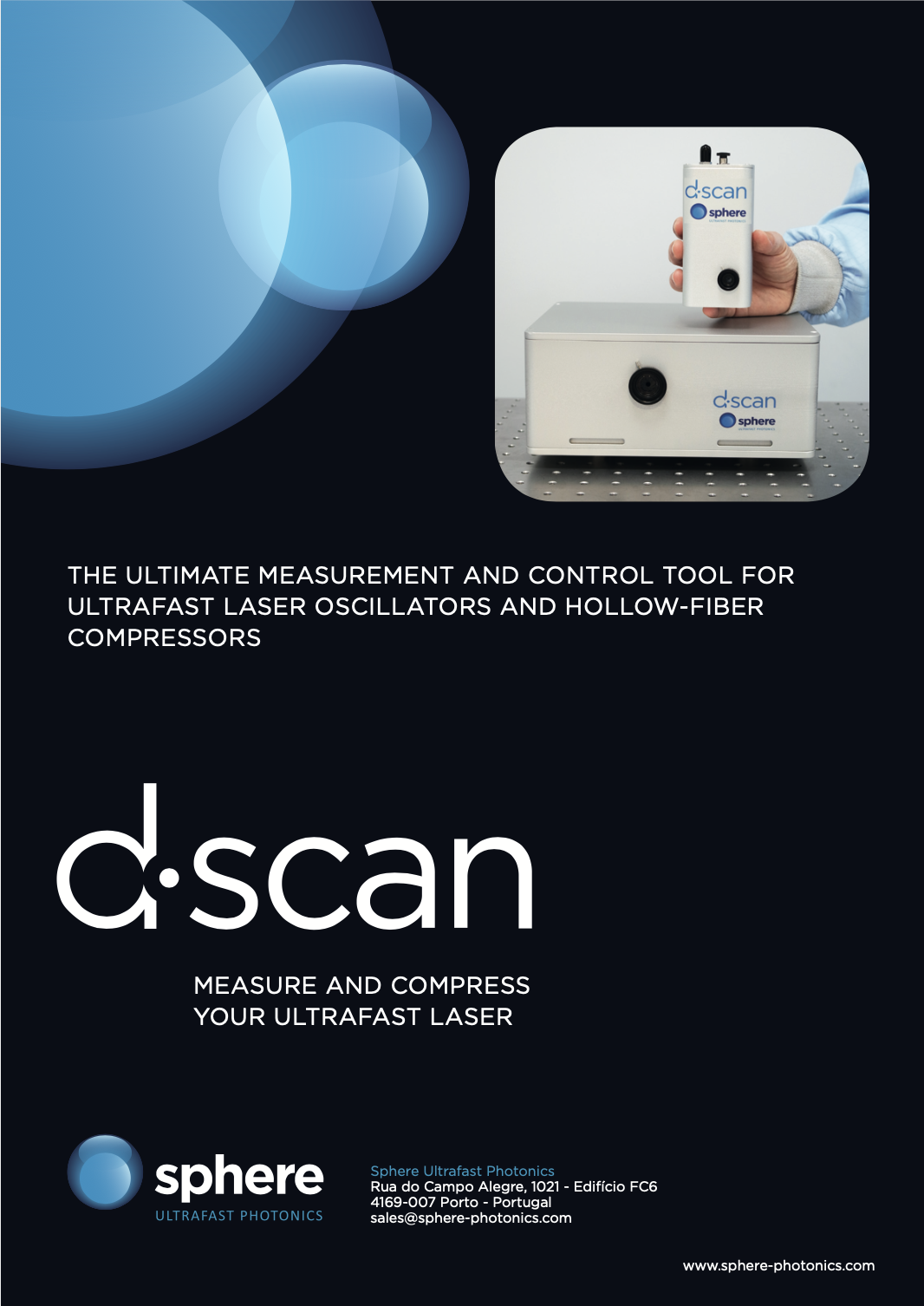
THE ULTIMATE MEASUREMENT AND CONTROL TOOL FOR ULTRAFAST LASER OSCILLATORS AND HOLLOW-FIBER COMPRESSORS
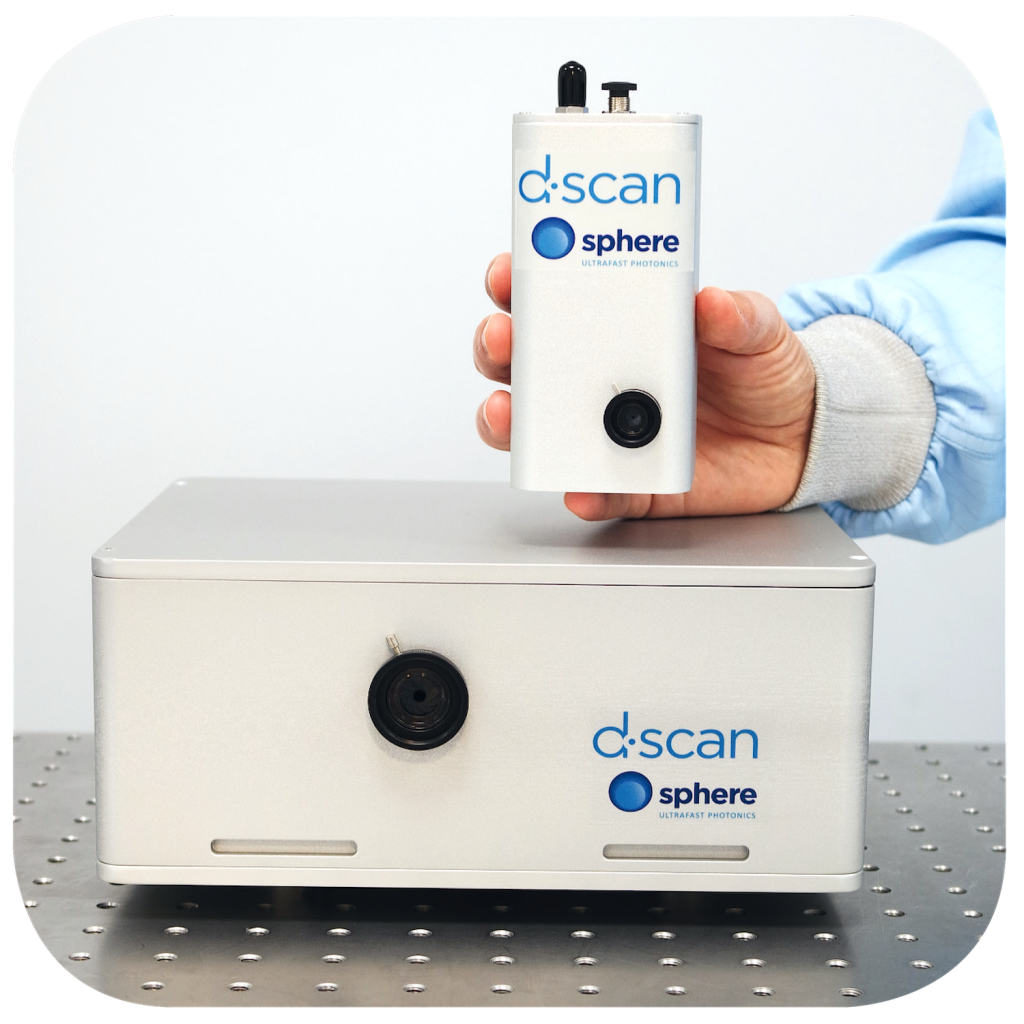
d-scan is an inline, compact and high-performance device for the simultaneous measurement and compression of even the most demanding ultrafast pulses.
d-scan handles broadband oscillators, amplifiers, OPAs, Hollow fiber and Multi-pass cell compressors. Coupling your beam into the d-scan is easily achieved in less than one minute and a full measurement takes less than 10 seconds.
d-scan traces are very intuitive and a proprietary algorithm provides accurate retrieval of the full electric field of the pulses, including its exact duration.
With d-scan you can change the dispersion added to the laser pulses, and adjust the pulse duration and peak power at the target position.
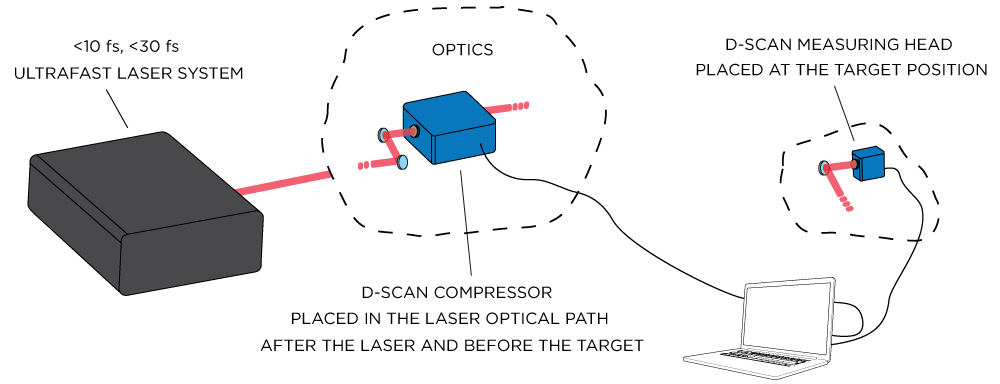
How to align a d-scan
Take a look at the video, you will see how simple, fast and straight forward is to align the d-scan and take a measurement!
Measurement examples
Oscillator
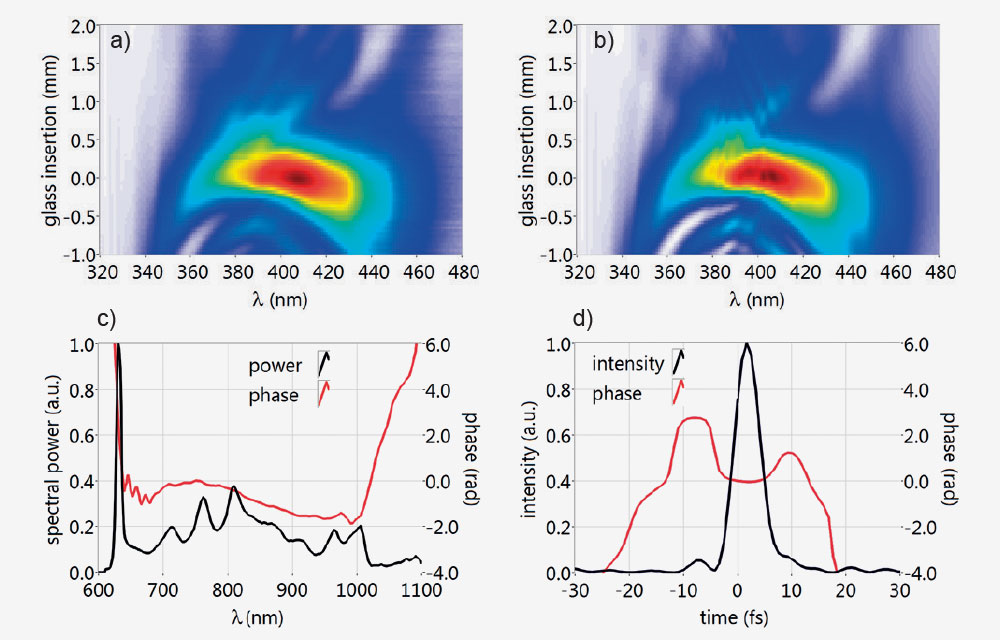
Few-cycle Ti:Sapphire oscillator: Measured (a) and retrieved (b) d-scan traces. (c) Measured spectrum (black) and retrieved spectral phase (red). (d) Retrieved temporal profile (black) and phase (red). Pulse duration is 5.5 ± 0.1 fs (FWHM).
For more details please check:
M. Miranda, P. Rudawski, C. Guo, F. Silva, C. Arnold, T. Binhammer, H. Crespo, and A. L’Huillier, “Ultrashort laser pulse characterization from dispersion scans: a comparison with SPIDER,” in CLEO: 2013, OSA Technical Digest (online) (Optical Society of America, 2013), paper JTh2A.31 (San Jose, CA, USA, 9-14 June 2013).
Hollow Fiber Compressor
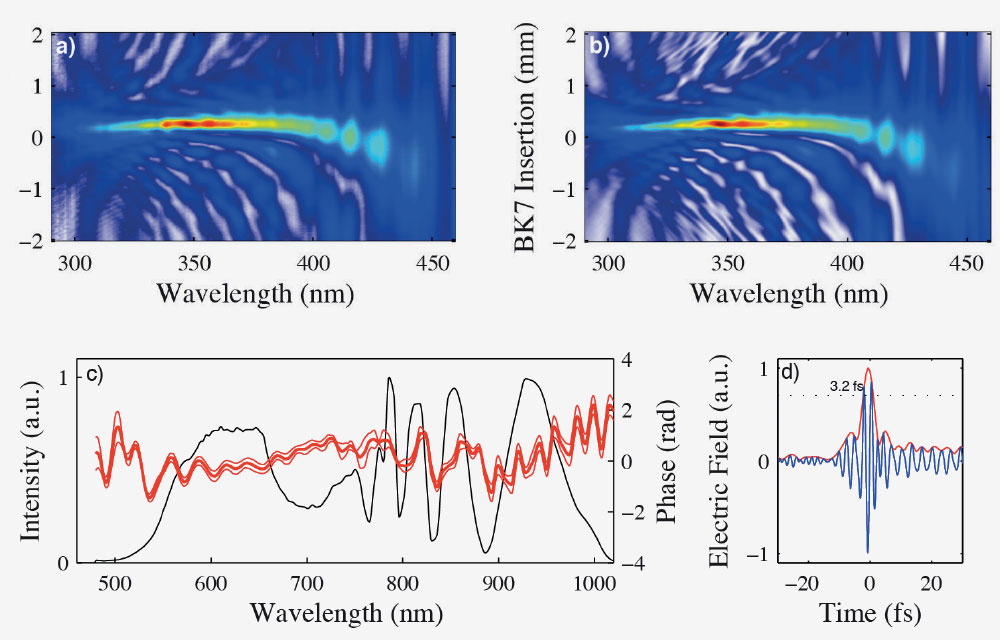
Single-cycle hollow-fiber compressor: Measured (a) and retrieved (b) d-scan traces. (c) Measured spectrum (black) and retrieved spectral phase with standard deviation (red). (d) Retrieved temporal profile for the wedge insertion that minimizes the pulse duration, corresponding to 3.2 fs (1.3 cycles at 740 nm).
For more details please check:
F. Silva, M. Miranda, B. Alonso, J. Rauschenberger, V. Pervak, and H. Crespo, “Simultaneous compression, characterization and phase stabilization of GW-level 1.4 cycle VIS-NIR femtosecond pulses using a single dispersion-scan setup,” Opt. Express 22, 10181-10191 (2014)
Brochures
Click to download our brochures
Click to go to the d-scan product page.
d-max
THE ULTIMATE TEMPORAL MEASUREMENT TOOL FOR ULTRAFAST LASER OSCILLATORS, MULTI PASS CELLS AND HOLLOW-FIBER COMPRESSORS
d-max is a temporal diagnostic device used to measure laser pulses typically at a target position, after sampling the beam. It is a compact and high-performance device that require small pulse energies for the measurement, and is designed for broadband oscillators, OPAs, Hollow fiber and Multi-pass cell compressors.
d-max has a wide dispersion range, enabling the measurement of a broad range of pulse durations and spectral bands supporting pulses down to few-cycles.
Coupling your beam into the d-max is easily achieved in less than one minute and a full measurement takes less than 10 sec.
d-max traces are very intuitive and a proprietary algorithm provides accurate retrieval of the full electric field of the pulses (spectral-domain intensity and phase, time-domain pulse profile).
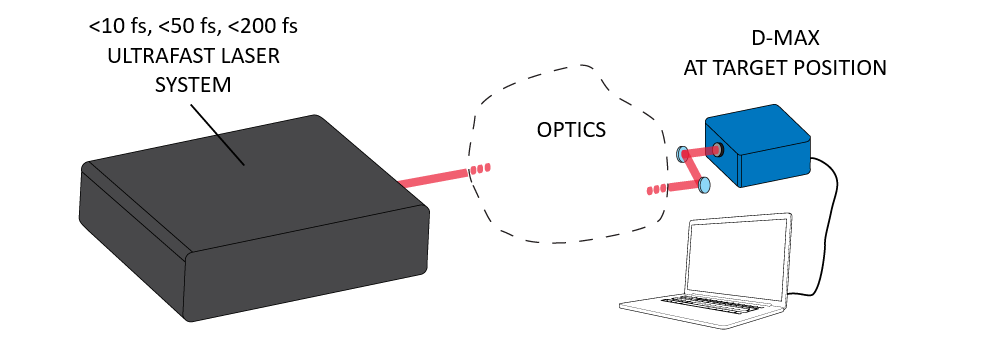
How to align a d-max
Take a look at the video, you will see how simple, fast and straight forward is to align the d-max and take a measurement!
Measurement examples
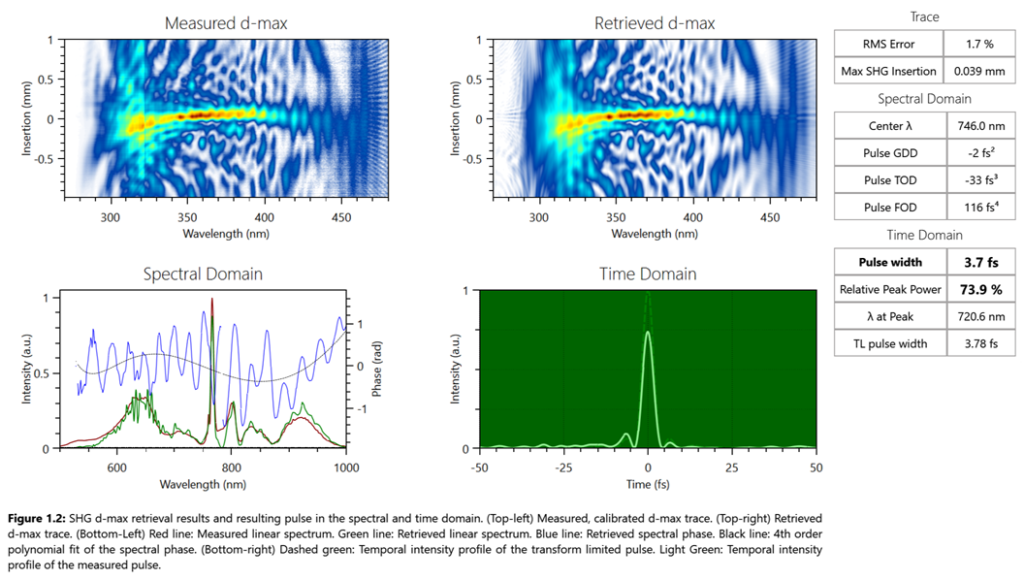
Hollow Core Fiber, FWHM pulse duration < 4 fs
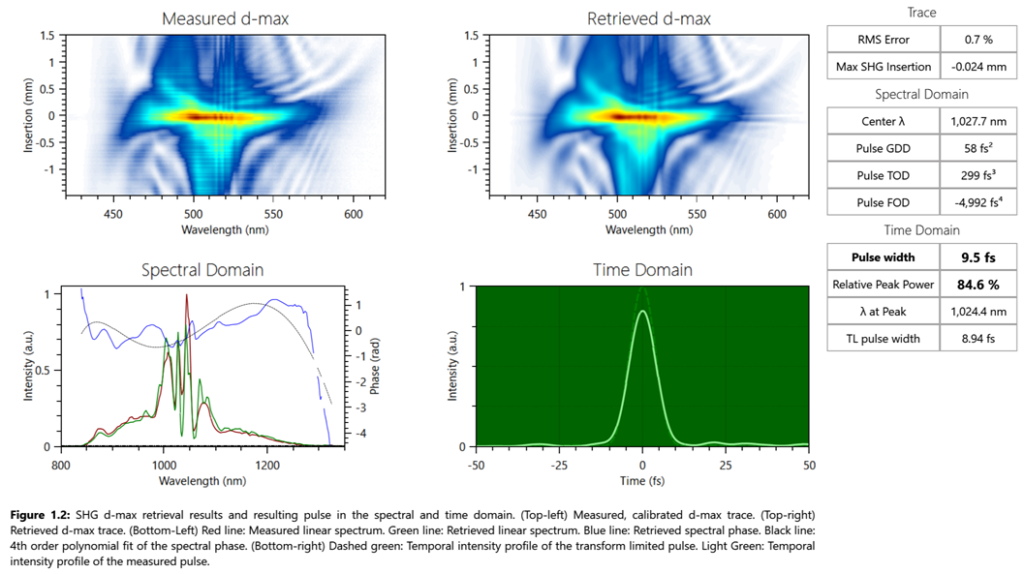
MPC at 1030 nm, FWHM pulse duration < 10 fs
Brochures
Click to download our brochures

Click to go to the d-max product page.
b-shot
SINGLE SHOT MEASUREMENT TOOL FOR HIGH PEAK POWER LASER SYSTEMS – ULTRAFAST LASER AMPLIFIERS, MUTI-PASS CELL COMPRESSORS, HOLLOW-FIBER COMPRESSORS AND
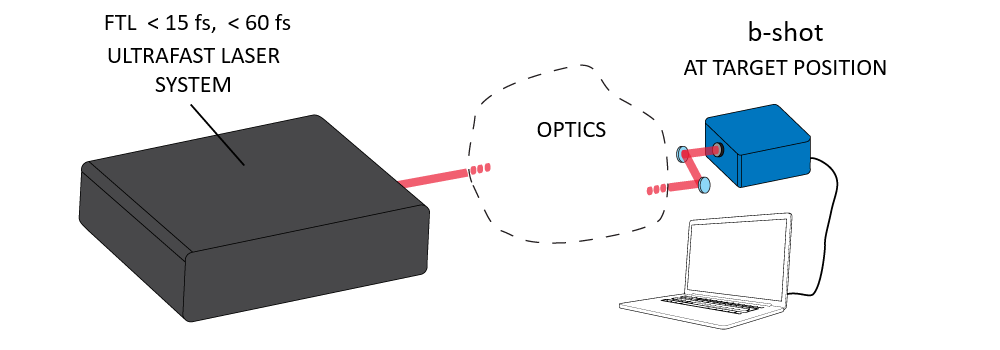
b-shot is a compact and high-performance diagnostics for single shot measurement of even the most powerful ultra-fast laser pulses.
b-shot handles amplifiers, OPAs, Muti-pass cell (MPC) and up to PW level laser systems.
Coupling your beam into the b-shot is easily achieved in less than one minute and measurements are made live, at video rate, allowing real-time adjustment of your laser system.
Time-stamped spectral data can be saved at > 20 Hz, together with selected pulse characteristics, such as pulse duration.
b-shot traces are very intuitive and a proprietary algorithm provides accurate retrieval of the full electric field of the pulses.
Click to go to the b-shot product page.
Tips
From the d-scan trace you can get a lot of information regarding the spectral phase of your ultrashort pulse
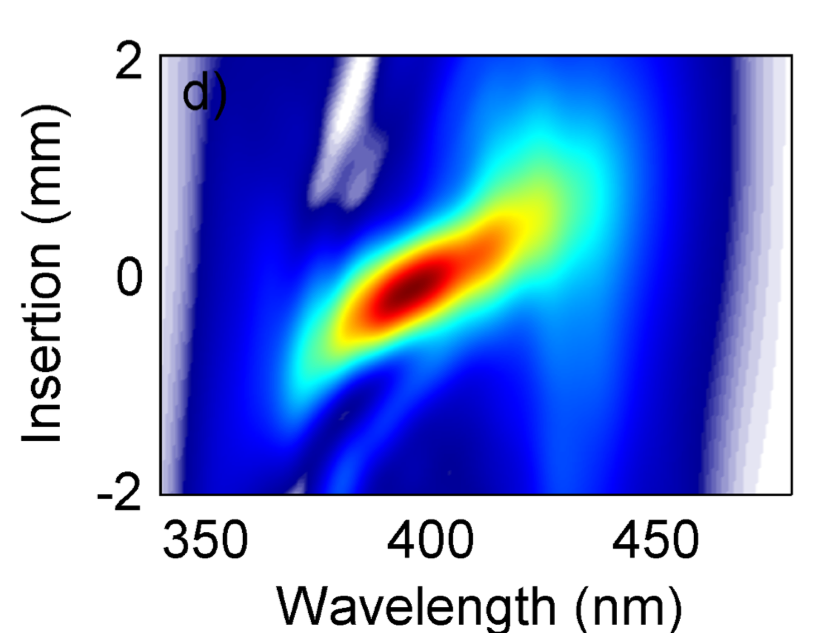
A tilt in the trace tells you that there is residual TOD
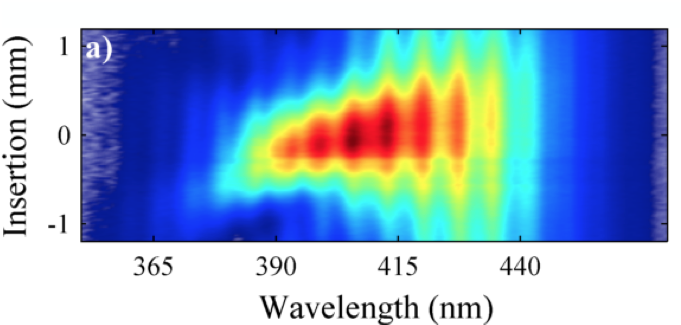
Spectral modulations are usually caused by misaligned chirped mirrors
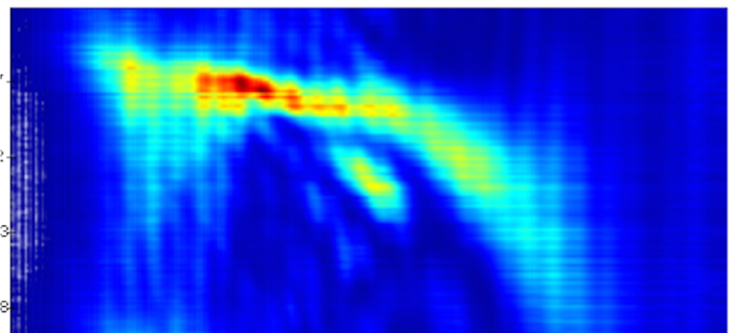
Whiskers are the sign that compression is diverging somewhere
Which product for which laser system?
Sphere Ultrafast Photonics products are suited for any application that requires femtosecond temporal duration measurement and optimization of the spectral phase at a given plane in order to get the shortest pulse on target
Few-cycle pulses
The d-scan and d-max are the products suited for this application.
Thanks to our technology we can measure and compress the most demanding ultrashort pulses. In 2018 we established the World Record for the shortest pulse ever achieved (and measured!), with 2.2 fs at the output of a single-channel hollow-core fiber compressor. How many companies do you know that produce devices that can handle such broad spectra and short pulses? I give you the answer: there are no other companies in the market that can do it! Our technology, experience and know-how allow us to adapt our system to the most challenging dispersion ranges and broad spectra, going from 450nm to 1.7um, as nobody else can.
Please have a look at these papers to see how far you can get with your hollow-core fiber or multi-pass cell setup
Strategies for achieving intense single-cycle pulses with in-line post-compression setups
F. Silva, B. Alonso, W. Holgado, R. Romero, J. San Roman, E. Conejero Jarque, H. Koop, V. Pervak, H. Crespo, and I. J. Sola
Vol. 43, No. 2 / January 15 2018 / Optics Letters
https://www.osapublishing.org/ol/abstract.cfm?uri=ol-43-2-337
All-optical measurement of the complete waveform of octave-spanning ultrashort light pulses
M. Miranda, F. Silva, L. Neoricic, C. Guo, V. Pervak, M. Canhota, A. S. Silva, I. J. Sola, R. Romero, P. T. Guerreiro, A. L’Huillier, C. L. Arnold And H. Crespo
Vol. 44, No. 2 / 15 January 2019 / Optics Letters
https://www.osapublishing.org/ol/abstract.cfm?uri=ol-44-2-191
Ultrafast Oscillators and Amplifiers, OPCPA, OPA
The d-scan, b-shot and d-max are the products suited for this application.
Our products are quite versatile and can be adapted to many different needs.
If you want to investigate how the spectral phase changes from one pulse to another, you might want to use a b-shot.
If you want to check your pulse duration at several planes in your laser chain and be able to compress it at the chosen plane, then you might go for a d-scan, which has a moving measuring head.
If you need a fixed diagnostic to check regularly your laser always in the same conditions, you might want to use a d-max.
If your needs are different from the one above, please feel free to contact us, we will be happy to help you out.
High peak power lasers
The b-shot is the product suited for this application.
High Power Lasers usually have a low repetition rate, that can go down to 1 shot every several minutes. In this case a single shot device is required, with the possibility to be triggered by an external electrical signal. Our single shot system, the b-shot, is particularly suited for this application, different models covering the temporal duration range from 6 fs to 60 fs, which is typical for these kind of laser systems. Moreover, shot-by-shot changes in the spectrum or spectral phase can be easily detected and saved.
To let you feel reassured, state of the art laser facilities like ELI pillars, APOLLON, Berkeley NL and others, have already installed our systems and are using them on a daily base, giving us a great feedback.
CEP-tag
The CEP-tag device provides measurement of the Carrier Envelope Phase (CEP) offset of amplified laser pulses at single-shot. It is based upon traditional f-2f interferometry, where the second harmonic of the red edge of an octave-spanning spectrum is spectrally interfered with the blue edge. Detection is based on a photodiode array and the use of Field-Programmable Gate Array (FPGA) electronics enables us to determine the CEP at a rate of 170 kHz.
ICE Spatio-temporal
The ICE device performs spatio-temporal characterization of femtosecond laser pulses with duration of 3 fs to 30 fs (in the Fourier transform limit), and a useable beam input aperture of up to 12 mm . The software GUI application allows post-processing of the acquired data to extract useable information such as Zernike polynomials, spatial chirp along X and Y as a function of wavelength, and more. The wave-propagation simulation tool allows you to simulate the waveform under forward or backward propagation, and the use of focusing optics.